
Dry Ice for Laboratory and Research Work
Pellet and block orders for laboratory and research use are reviewed against the protocol, equipment and sample-handling requirements. Include purchasing frequency to discuss specifications, available documents and delivery conditions.
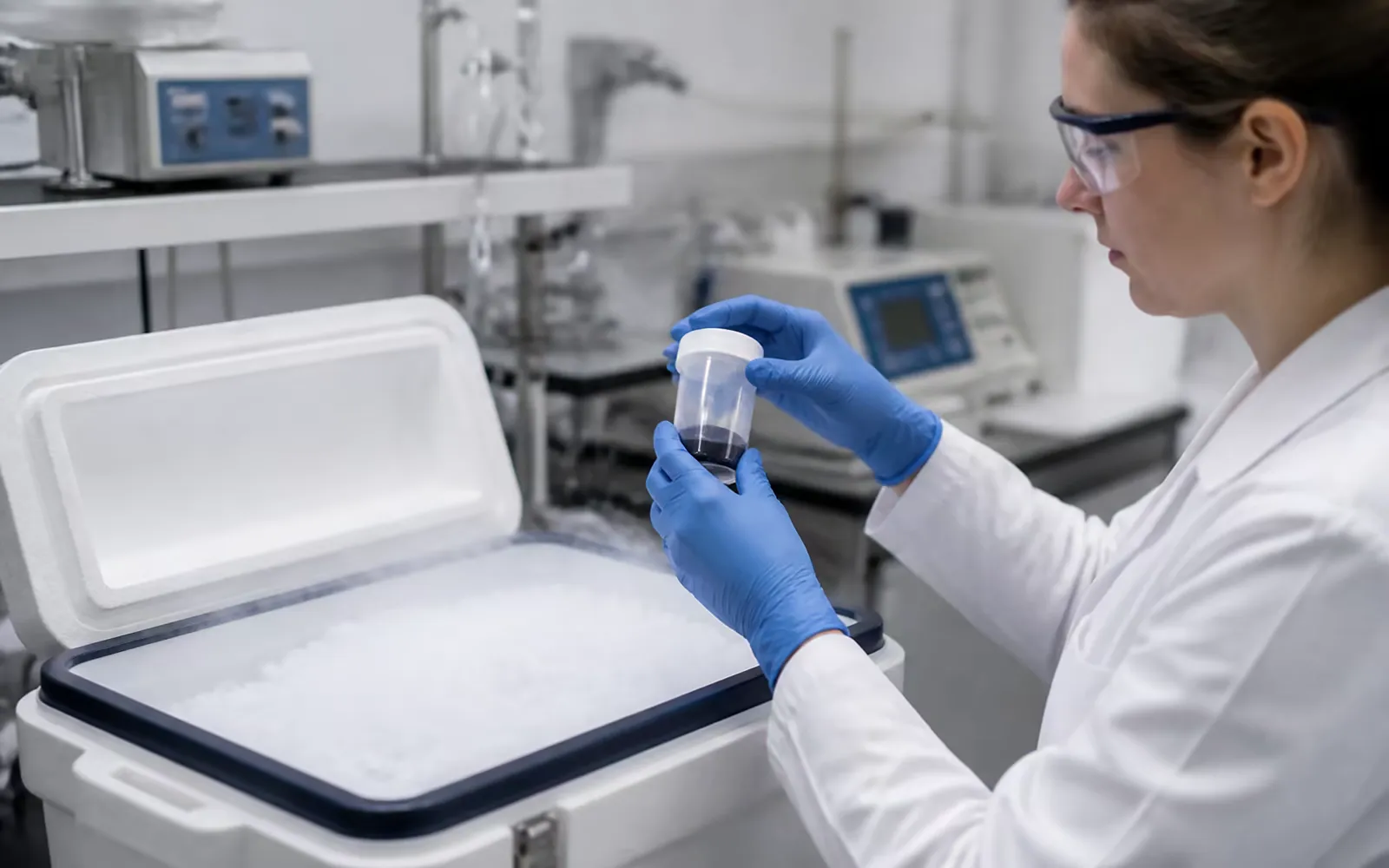
In laboratories, dry ice is both a portable cold source and a practical aid for many workflows. It can support short-term sample holding, low-temperature reactions, grinding, transfers and demonstrations, but its fast sublimation and carbon-dioxide release mean temperature control, suitable vessels, ventilation and records all matter equally.
Why laboratories use dry ice
Samples can change quickly after leaving a refrigerator or cold instrument: proteins may lose activity, nucleic acids may degrade, enzymes may continue reacting, and plant or tissue materials may soften, oxidise or lose moisture. Dry ice creates a short operating window during transfer, aliquoting and waiting periods.
Unlike ice water, it does not leave meltwater and can be useful around dry benches, instruments or sealed outer packaging. It can also form low-temperature baths with an appropriate medium. It is intended for temporary or process cooling, not as an automatic substitute for a freezer, ultra-low freezer or liquid-nitrogen system.
Hold and transfer samples safely
Before transport, pre-cool, aliquot and identify samples according to the study plan. Use sealed, low-temperature-compatible inner packages and label each with sample ID, date, operator, hazard information and target range. Plan labels so they remain readable in low temperatures.
Do not let containers be compressed directly by dry ice: glass, ordinary plastics and some seals can become brittle. Use an insulated shipper with a carbon-dioxide vent, add a logger for important material, and record pack-out, handover and receipt. If dry ice is exhausted or temperature is abnormal, assess the material against the study plan rather than assuming re-freezing restores validity.
Use low-temperature baths by measurement
Dry ice combined with water, alcohol or another appropriate medium can temporarily cool a reaction, lower sample temperature or hold a short process condition. The actual temperature depends on the medium, ratio, vessel shape and heat load, so use a verified thermometer or sensor instead of assuming that a dry-ice bath has reached a particular value.
Choose a stable low-temperature-compatible vessel, place it in a non-slip tray and add dry ice slowly with ventilation. When organic solvents, volatile materials or flammables are present, follow laboratory chemical-safety requirements for compatibility, vapour risk and waste handling.
Support low-temperature grinding
Cold treatment can make soft tissue, plant material and oily samples more brittle, helping produce a more even grind while limiting heat generation, loss of volatile components and enzyme-driven change. For samples where structure or activity matters, lower temperature can also reduce oxidation and degradation during handling.
Control dry-ice quantity, particle size and operation time. Avoid temperatures that crack a vessel, and avoid trapping large amounts of sublimating dry ice in a closed container. Confirm that dry ice has fully sublimated before weighing, extracting, sealing or heating the processed material.
Teaching and engineering studies
Sublimation can support controlled demonstrations of phase change, gas expansion and temperature effects in physics, chemistry and environmental teaching. In engineering work, dry ice can assist temporary component cooling, seal checks, condensation observations and short-duration low-temperature simulations.
Keep the quantity controlled, prevent direct hand contact and prioritise ventilation and orderly supervision over a dramatic visual effect. For materials, sensors and small equipment, dry ice is useful for screening and early trials, but accurate, stable temperature data requires a feedback-controlled low-temperature system.
Storage, safety and disposal
Wear insulated gloves and eye or face protection and work in a well-ventilated space. Do not store dry ice in a sealed refrigerator, cabinet or confined room. A storage vessel needs insulation but must not be airtight, and the laboratory should assess carbon-dioxide risk from room volume, use rate and ventilation; gas monitoring may be appropriate.
Small residues may sublimate in a designated ventilated area, but contaminated materials, sample residues, solvents and biological materials must follow their own hazard-disposal routes. Record quantity, location, sample status and exceptions so the work can be reviewed and staff can be trained consistently.
Plan supply and routine management
Purchase planning should specify pellet or block form, expected use period, delivery packaging, supply frequency and receiving responsibility rather than only ordering a box. Too little can interrupt experiments; too much increases storage and ventilation pressure. Forecast against the experimental schedule and keep a sensible contingency for urgent samples or transfers.
A short issue log can record quantity, use area, experiment or sample, balance and exceptions. Train new users on the essential rules: no bare-hand contact, no sealed storage and no sealing of a container that still contains dry ice. Shared facilities should assign responsibility for issue records and training files.
Conclusion
Dry ice is fast, flexible and dry, which makes it useful for sample protection, reaction cooling, grinding, engineering tests and teaching. Its limits are rapid sublimation, less stable control than dedicated equipment, and cold-burn and carbon-dioxide hazards. Standard procedures, the right container, temperature records and ventilation make it a reliable laboratory aid.
Discuss Dry Ice for Your Application
Send us the operating conditions, quantity, delivery location and required date. We will review the available product and supply options with you.